What to know
- Tiny Aya L2 Thinker has 3.35 billion parameters and a 32K context window.
- Cohere reports language-consistent reasoning in more than 93% of tested cases.
- The model card specifies a CC BY-NC 4.0 noncommercial license.
The release tests language-consistent reasoning
Cohere introduced Tiny Aya L2 Thinker on October 6, a 3.35-billion-parameter model with a 32K context window. Its training mixes English reasoning, translated reasoning across 44 languages and multilingual material without reasoning traces. The company reports that generated reasoning matched the prompt language in more than 93% of evaluated cases across 60 languages.
Cohere reports accuracy declines of roughly two to three percentage points on five of six evaluated benchmarks, with a larger decline on the competition-mathematics benchmark PolyMath. These are company-reported results. The model card lists a CC BY-NC 4.0 license and additional acceptable-use terms. Access to weights therefore should not be interpreted as unrestricted permission for commercial deployment.
Source: Cohere: Building multilingual bridges with Tiny Aya · Cohere Labs: Tiny Aya L2 Thinker model card and license
Analysis: Language consistency is one part of usefulness
A system that accepts a question in one language but produces its explanation in another can be difficult to evaluate or use in a local workflow. Keeping the explanation in the requested language can make review more accessible to the person responsible for the task. It also allows an evaluator to inspect whether terminology, assumptions and references fit the setting in which the answer will be used.
That benefit does not establish that the explanation faithfully describes the model’s internal computation. A generated reasoning trace is text produced by the system, and it can contain a plausible account that does not justify the final answer. Evaluation needs to examine the answer and its supporting evidence directly. Agreement between the prompt language and explanation language is a useful measurement, but it should remain distinct from correctness.
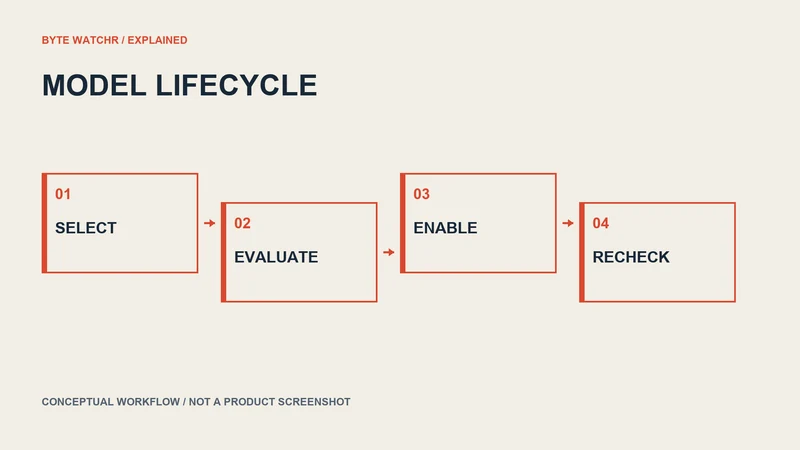
The benchmark tradeoff is also relevant to model selection. An improvement in language consistency can coexist with lower task accuracy. A team should compare both outcomes on examples representative of its intended use, including native-language material rather than only translated English questions. Technical vocabulary, regional conventions and ambiguity can change the difficulty of a task even when the surface language looks fluent.
Research evaluation should include local constraints
The relatively small parameter count offers a concrete starting point for experiments with constrained hardware. It does not determine deployment cost on its own. Context length, output length, reasoning traces, precision and the serving implementation all affect memory use and response time. Researchers should measure those conditions on the equipment and workloads they actually intend to use.
License review belongs at the beginning of that evaluation. A noncommercial research release may support an experiment without supporting the proposed production use. Teams should retain the model version, applicable terms and evaluation records so that later decisions are based on the specific artifact tested. A similarly named model or a later release can have different capabilities and conditions.
Tiny Aya L2 Thinker provides evidence about a particular training approach to multilingual reasoning. The next useful comparison is whether its language behavior and task accuracy hold for the languages, domains and hardware relevant to an intended application. That assessment should preserve both the reported gains and the measured limitations rather than treating the number of supported languages as a complete description of model quality.
Sources & further reading
- Cohere: Building multilingual bridges with Tiny Aya
- Cohere Labs: Tiny Aya L2 Thinker model card and license
Factual statements are grounded in the linked material. Interpretation and illustrative examples are Byte Watchr analysis. Vendor claims are identified as claims, rather than independent testing.
The event date records the source announcement or documented operation. The coverage edition groups recent developments and is separate from the publication date. Actual publication is recorded above.
Corrections policy · About this byline