
What to know
- FieldAI is reportedly raising $700 million at a $10 billion valuation.
- Its platform is designed to work across multiple kinds of robots.
- Physical deployments require evidence about failure handling, supervision and operating limits.
Capital moves toward general-purpose robot software
Business Insider reported on October 3 that FieldAI is set to raise $700 million at a $10 billion valuation. The company develops software intended to provide a general-purpose autonomy layer across robots including industrial machines, drones and humanoid platforms. The report says FieldAI has secured commercial work across construction, data centers and defense. Because the financing was described as set to close, the final terms should be treated as pending until the company confirms completion.
The investment thesis is larger than one robot design. A software layer that transfers across bodies and environments could reduce the cost of building separate autonomy stacks for every machine. That promise also raises the evaluation burden. A system that performs well in a controlled warehouse may encounter different sensing, timing and safety constraints on a construction site or around critical infrastructure.
Source: Business Insider: FieldAI set to raise $700 million at a $10 billion valuation · FieldAI company site
Analysis: Physical AI has consequences that simulations can hide
Errors in a text model can be costly, but errors in a moving machine can damage equipment or injure people. Physical AI therefore needs operating envelopes that specify where the system has been tested, what conditions trigger a stop and which actions always require human approval. A broad claim of generality should not erase the narrow conditions under which a particular deployment is safe.
Funding can accelerate data collection, hardware integration and field testing. It can also create pressure to expand before failure modes are understood. Customers should distinguish demonstrations from sustained operation and reported contract value from deployed revenue. Useful evidence includes intervention rates, incident severity, recovery behavior and performance under degraded sensors or communications.
What buyers and investors should demand
A buyer should begin with the task, environment and consequence of failure. The vendor should explain how the system recognizes uncertainty, how operators regain control and whether logs are sufficient to reconstruct an incident. Updates need change management because a new model can alter behavior even when the physical machine is unchanged.
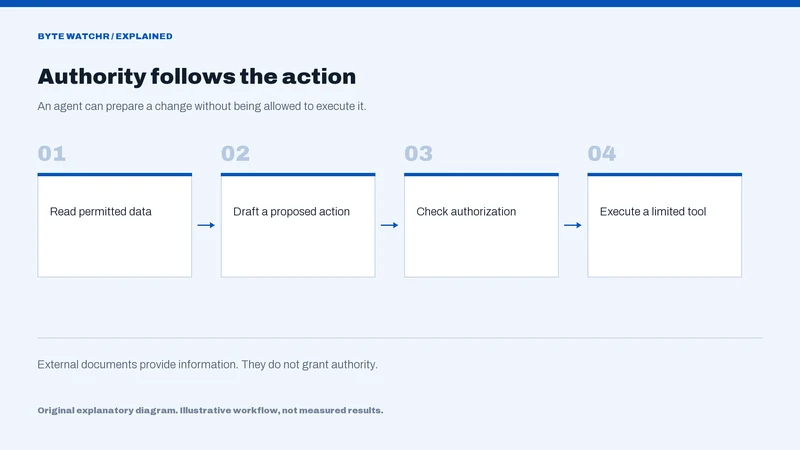
Security is part of the safety case. Robots connect sensors, networks, cloud services and maintenance interfaces. Weak credentials or excessive remote authority can turn a software compromise into a physical event. Access should be segmented, commands authenticated and emergency controls designed to work even when higher-level autonomy is unavailable.
FieldAI’s reported round shows how strongly investors are backing physical AI. The durable value will come from more than a general-purpose narrative. It will come from evidence that one software architecture can adapt across machines without making its boundaries impossible to understand. Scale is consequential only when deployment discipline scales with it.
Sources & further reading
Factual statements are grounded in the linked material. Interpretation and illustrative examples are Byte Watchr analysis. Vendor claims are identified as claims, rather than independent testing.
The event date records the source announcement or documented operation. The coverage edition groups recent developments and is separate from the publication date. Actual publication is recorded above.
Corrections policy · About this byline


_07.png)