What to know
- The announcement described both infrastructure action and a victim-support effort.
- A disconnected command path does not establish a healthy endpoint.
- Clear handoffs can make remediation progress easier to measure.
What was confirmed
On September 1, 2026, DOJ announced action against the Sality botnet involving the United States, Bulgaria, Hungary, and Romania, with CrowdStrike and the Shadowserver Foundation. It described a peer-to-peer network whose infected computers relayed commands.
The release placed a sinkhole operation on the preceding Monday, August 31. U.S. authorities seized domains, while European partners acted against others. Shadowserver was working with internet providers and incident-response teams on identifying infections, notifying victims, and remediation. The announcement date and operational date are distinct in this retrospective.
Source: Sality Malware Disrupted in International Cyber Takedown
Analysis: The network and the owner have different milestones
An intervention can change an attacker's infrastructure before it changes an affected owner's circumstances. A device owner might still need to understand what happened, determine the scope, and decide what recovery requires. Treating the infrastructure action as the end of the incident would leave those questions unanswered.
Consider a hypothetical organization learning that one of its systems appeared in an investigation. The first challenge may be identifying the correct system and responsible team. The next may be distinguishing a historical observation from a current condition. Only after that can the organization assess what the evidence implies. Each step has a different completion criterion, and success at an earlier step does not automatically satisfy the later one.
Analysis: Notification is a product of the operation
A notification has to carry enough context to be useful without pretending to contain a complete diagnosis. The recipient needs to understand what was observed, when it was observed, and which part of the information remains uncertain. Otherwise, a technically accurate alert could create confusion about ownership or urgency.
An effective handoff would also need a route for correction. If an organization cannot match the observation to its records, that disagreement is information worth preserving. If a service provider forwards the notice, the next recipient should still be able to understand its provenance. These are analytical requirements for an accountable process, not claims about the exact notification workflow used in the Sality operation.
Analysis: Recovery needs its own denominator
Counting notices sent would describe one activity, but it would not establish how many affected parties understood or acted on them. Counting responses would describe another. A stronger account of recovery would have to say what completion means and which population is being measured.
Suppose, purely as an example, an operation identifies a group of potentially affected systems but reaches owners for only some of them. Reporting a high completion rate among respondents could obscure the unresolved remainder. Reporting only the total population could conceal substantial progress within the reachable group. Both views may be useful if their boundaries are clear. The same principle applies to any later account of this operation: readers need a denominator before a success rate has meaning.
What remains unproven or unknown
The DOJ release does not provide a complete victim count or establish that every infection was removed. Byte Watchr has not examined affected systems or independently reproduced the operation's results. The source supports the reported actions and the stated remediation effort.
Further evidence would be needed to evaluate the reach and durability of that effort. How many notifications reached a responsible owner? What portion led to a verified resolution? What remained uncertain after follow-up? Those questions should not be converted into an accusation of failure simply because the announcement does not answer them. They identify the work required for a fuller assessment of recovery, which is different from assessing whether a specific infrastructure action occurred.
Source: Sality Malware Disrupted in International Cyber Takedown
Practical implications: Keep the handoffs visible
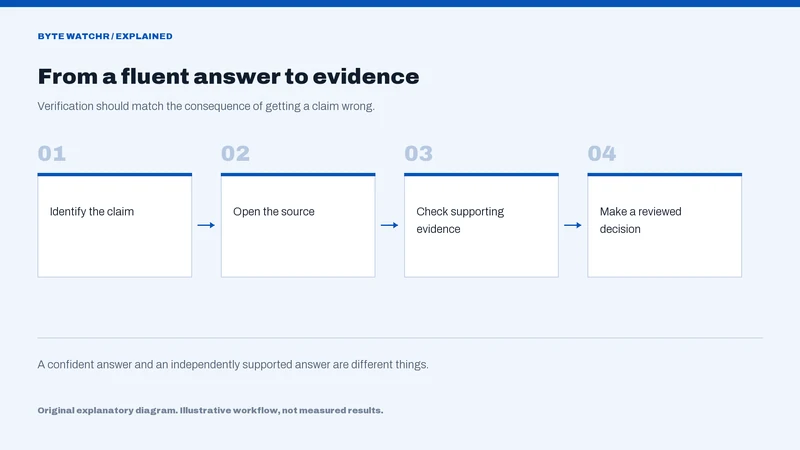
The useful lesson for an organization reviewing this case is to map responsibilities before assuming that an outside intervention resolves its own concerns. A tabletop discussion could follow an incoming notice from receipt through identification, investigation, decision, and documented closure. The exercise would reveal where a handoff lacks an owner without making claims about any current security product.
For readers following future updates, the most informative reporting would connect those stages. A disruption story becomes more complete when it explains how technical observations reach the people able to act, and how those people can report an outcome. The September announcement included that broader effort. Its eventual impact should be assessed with evidence about both the infrastructure and the people expected to recover from its misuse.
Sources & further reading
Factual statements are grounded in the linked material. Interpretation and illustrative examples are Byte Watchr analysis. Vendor claims are identified as claims, rather than independent testing.
This article belongs to Byte Watchr’s launch collection. The event date records the source announcement or documented operation. Actual publication is recorded above.
Corrections policy · About this byline