What to know
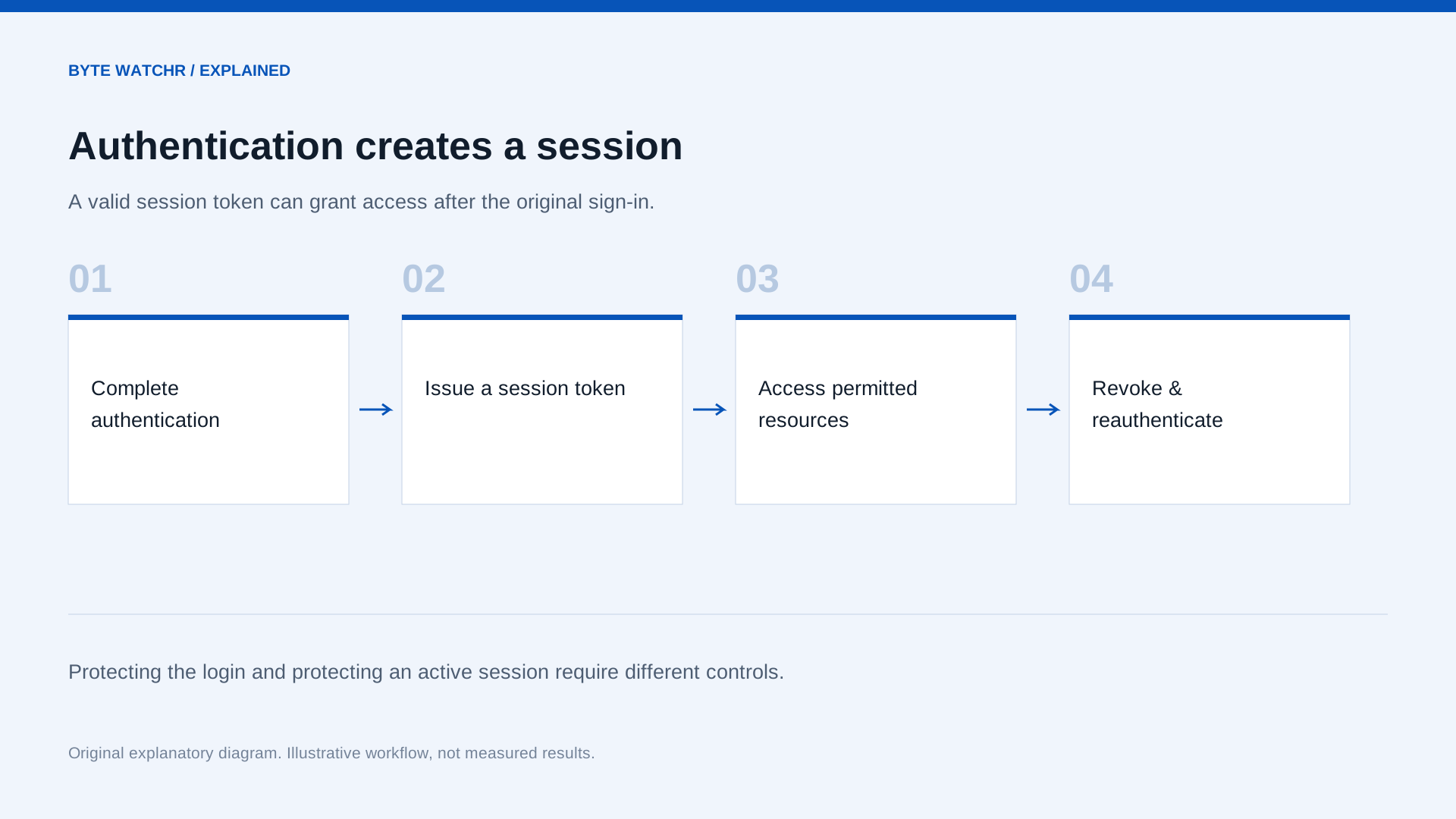
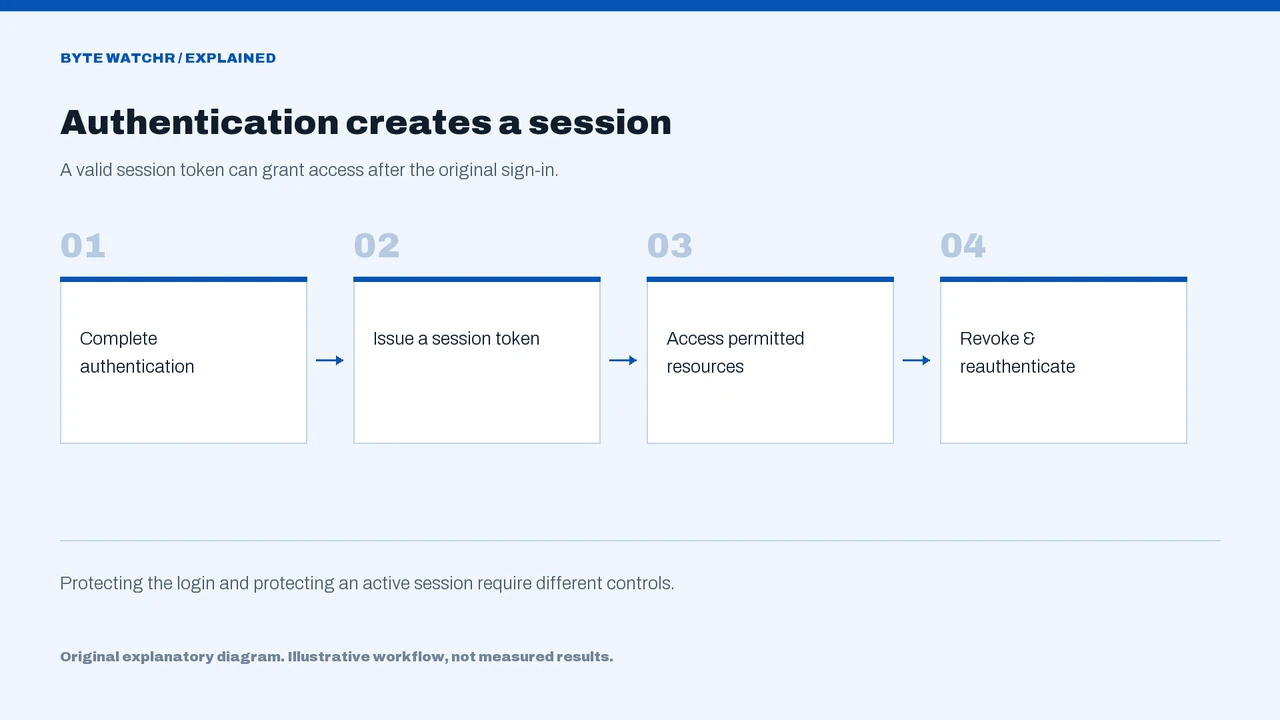
- A session can represent earlier authentication without repeating it on every request.
- Password changes and token revocation are separate mechanisms whose behavior must be verified.
- Shorter lifetimes, safer storage, reauthentication, and appropriate token binding can limit exposure.
Different tokens carry different powers
The word token can refer to several mechanisms. A browser session cookie, an API access token, and a refresh token are not interchangeable. Their audiences, lifetimes, and validation rules differ. Some are opaque references checked against server state; others contain signed claims. The relevant question is which service accepts the artifact and what additional proof that service requires.
In OAuth, refresh tokens can be used to obtain replacement access tokens subject to the authorization server’s rules. RFC 9700 discusses protections including refresh token rotation and sender-constrained tokens. Those mechanisms address specific threats and deployment conditions. A team should identify the token types in its own system before assuming that one logout button or one credential change invalidates them all.
Source: IETF RFC 9700: Best Current Practice for OAuth 2.0 Security
A password reset may leave a question open
Changing a password and terminating existing sessions are distinct operations. An application may connect them, but that behavior needs to be documented and tested. Consider a hypothetical employee who resets a password after a suspicious login. The meaningful follow-up is whether the unauthorized session can still read information, whether new access tokens can be obtained, and whether connected applications retain permission.
A recovery runbook should name the controls needed for the actual services involved. That could include revoking sessions, withdrawing an application grant, disabling a credential, and requiring fresh authentication. Avoid assuming that closing a browser deletes server-side authority. Also avoid assuming that removing one local cookie revokes a copy held elsewhere. The application’s enforcement mechanism determines the result.
Source: IETF RFC 9700: Best Current Practice for OAuth 2.0 Security · Ceron: Customer Portal Security Assessments: Protecting the Systems Your Clients Log Into
Protect the session where it is used
OWASP describes cookie attributes that reduce particular exposures. Secure limits a cookie’s transmission to secure connections, while HttpOnly prevents ordinary page scripts from reading it through the browser’s cookie API. SameSite can help constrain cross-site request behavior. These controls have distinct purposes and need to be combined with appropriate application design; none is a blanket defense against a compromised endpoint.
A useful architectural review follows a session value through browsers, proxies, logs, diagnostics, and support tooling. Does sensitive material enter a copied troubleshooting bundle? Can an unnecessary extension access the application? Are screenshots or support exports handled as potentially sensitive? The practical objective is to minimize the number of places that receive reusable authority and to give each place a clear reason.
Make sensitive actions earn fresh trust
A long-lived session can be convenient for ordinary reading while still requiring fresh authentication for a consequential operation. Changing a recovery address, adding another administrator, or exporting a large dataset may justify an additional check. NIST’s authentication guidance addresses reauthentication and session management, with requirements tied to assurance levels and context. Applications need to choose controls that fit their own risks.
In a hypothetical payroll system, viewing a routine notice and changing a payment destination should not necessarily depend on identical evidence of current user control. The extra check must itself use a sound method. Repeating a weak challenge adds inconvenience without resolving the underlying concern. The goal is a deliberate relationship between the action’s consequence and the assurance required at that moment.
Source: NIST SP 800-63B: Authentication and Authenticator Management
Treat revocation as a feature to test
Measure how long unwanted access can survive a revocation request across the services that matter. A central identity provider and a connected application can have different session states. Test ordinary logout, administrative revocation, account suspension, and suspected compromise using controlled accounts. Record the limits so responders know whether another service-specific action is required during an incident.
Session theft makes account security a continuing process. Strong initial authentication, protected clients, carefully scoped tokens, expiration, and workable revocation reinforce one another. A user should not have to infer which layer failed from a reassuring password reset message. A well-designed service makes the current access state understandable and gives both users and administrators an effective way to end it.
Source: IETF RFC 9700: Best Current Practice for OAuth 2.0 Security · OWASP: Session Management Cheat Sheet
Sources & further reading
- OWASP: Session Management Cheat Sheet
- IETF RFC 9700: Best Current Practice for OAuth 2.0 Security
- NIST SP 800-63B: Authentication and Authenticator Management
- Ceron: Customer Portal Security Assessments: Protecting the Systems Your Clients Log Into
Factual statements are grounded in the linked material. Interpretation and illustrative examples are Byte Watchr analysis. Vendor claims are identified as claims, rather than independent testing.
This article belongs to Byte Watchr’s launch collection. The edition date organizes evergreen coverage and does not imply historical publication. Actual publication is recorded above.
Corrections policy · About this byline