What to know
- Model behavior and application security need different tests.
- Use authorized test environments with realistic permissions and synthetic sensitive data.
- Record the failure mechanism and retest after the system changes.
Start with a concrete risk
A red-team exercise intentionally probes a system for failures under adversarial conditions. For AI, that can include attempts to extract protected information, manipulate answers or trigger actions beyond an approved scope. The exercise is useful when it begins with a specific risk and a defined testing boundary.
A general request to break the model may produce striking examples without showing whether the deployed application is vulnerable. A support assistant that can only draft text has different consequences from an agent that can issue credits or change account permissions.
Map the full path
Document where input arrives, which sources the model reads, what information enters its context and which tools can act on its output. Include indirect sources such as retrieved pages and attachments. These are important because the user’s own prompt is not the only material influencing the system.
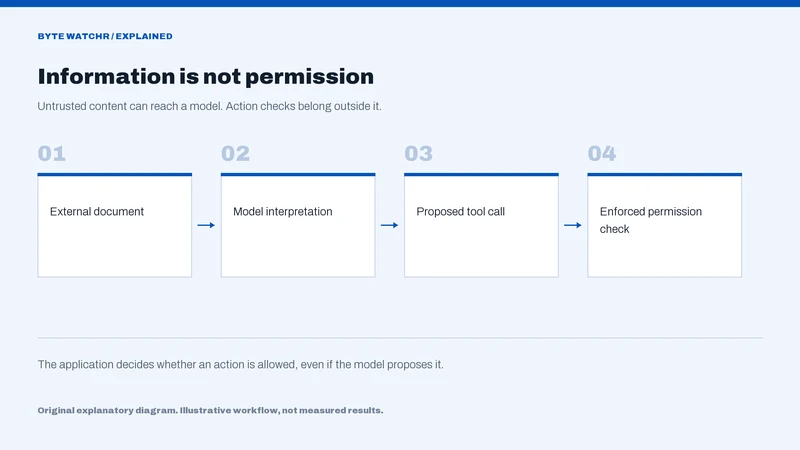
For a purchasing assistant, the map might run from a supplier document through retrieval to a recommendation and then to a payment preparation tool. Test the transition between each stage. A failure at the tool boundary can matter more than an unusual phrase in the generated explanation.
Design a safe, representative environment
Use test accounts, controlled integrations and synthetic records that resemble the important production cases. Scope the work explicitly and avoid directing tests at third-party services without authorization. A useful exercise should generate evidence, not create an uncontrolled incident.
Make the permissions realistic. If a test environment gives an agent broader access than production, the results may exaggerate impact. If it omits a consequential tool that production enables, the results may understate it. Document these differences so the findings can be interpreted correctly.
Separate observation from impact
Record what the model produced and what the application actually did. A model may propose a forbidden action while the tool correctly rejects it. Conversely, a harmless-looking answer may accompany an unauthorized API call. The outcome needs to include the side effect, not just the visible conversation.
Describe the failure mechanism, the prerequisites and the evidence. Include whether the result is repeatable and whether a particular configuration is required. This gives the engineering team a repairable problem rather than a screenshot that cannot be reproduced.
Evaluate the proposed fix
A prompt change may reduce one attack while leaving a related path open. Retest variations and inspect whether the control prevents unauthorized access independently of the model’s wording. Some fixes belong in the retrieval layer, identity system or tool implementation.
Keep successful and failed cases as a regression set. When models, prompts, document sources or tool permissions change, rerun the cases that exercise relevant boundaries. A red-team result is a statement about a particular system at a particular time, not a permanent certificate of safety.
Sources & further reading
- NCSC: Guidelines for secure AI system development
- NIST: Adversarial machine learning taxonomy
- Ceron: The AI Arms Race, by Mario Luckeneder (perspective; further reading added October 4, 2026)
Factual statements are grounded in the linked material. Interpretation and illustrative examples are Byte Watchr analysis. Vendor claims are identified as claims, rather than independent testing.
This article belongs to Byte Watchr’s launch collection. The edition date organizes evergreen coverage and does not imply historical publication. Actual publication is recorded above.
Corrections policy · About this byline