What to know
- Initial access is limited to selected cyber defenders.
- Broader availability remains a separate release step.
- Benchmark results need testing against operational workloads.
A staged release
Google announced Gemini 4 Argon on September 30, initially distributing the model to trusted cyber defenders in its Fairwind Program. The company describes applications in software engineering, enterprise work and vulnerability remediation. It says it is participating in the US government’s voluntary prerelease access process while gathering feedback before broader distribution.
The announced introductory rates are $2 per million input tokens and $10 per million output tokens, with cached input discounted by 95%. Those are prospective launch terms, not evidence that every developer can already obtain access. The distinction matters for organizations planning a migration: an announced model and an available service occupy different places in a deployment schedule.
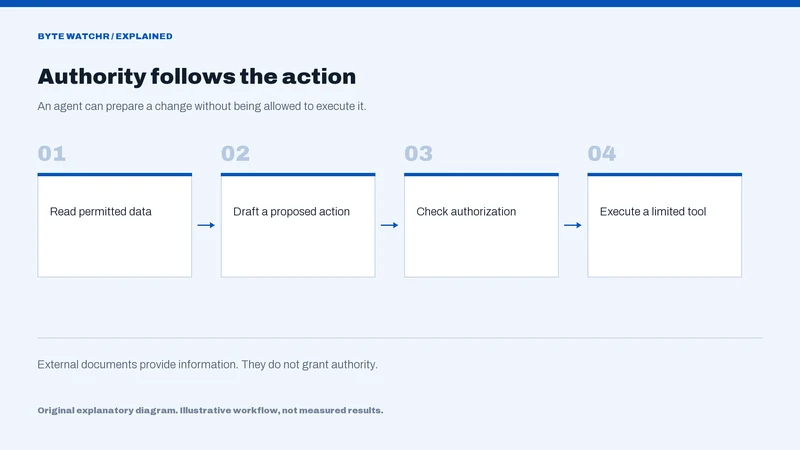
Capability and permission are separate decisions
For security teams, the immediate question is what an evaluation environment should allow the model to do. A system that identifies a suspected vulnerability may need source access and a test environment. A system that applies repairs also needs rules for changing code, running checks and requesting approval. Each additional capability creates a separate decision about ownership and evidence.
A useful trial would follow a finding through reproduction, repair and regression testing. Counting proposed bugs alone can reward a system that generates work for reviewers without improving security. Counting accepted patches alone can miss problems introduced elsewhere. The more informative measure is a verified defect removed without a new failure, including the time people spent checking the result.
The same principle applies to enterprise knowledge work. A convincing document can still depend on an outdated source, a missed exception or a permission error. Organizations need examples that resemble their own records and processes, with a clear definition of an acceptable result. A leaderboard position cannot establish those conditions for a particular customer.
What broader access will need to establish
Byte Watchr’s assessment is that the phased release makes operational evidence especially important. Early users can help reveal whether the model remains effective when its inputs are incomplete, its tools fail or its first approach proves wrong. Those cases often determine whether an agent can be trusted with a longer assignment.
Cost evaluation should include the full workflow. Repeated attempts, long intermediate outputs, external tools and human review can change the economics of a task even when the token rate appears modest. A comparison should therefore hold the workload and acceptance standard constant rather than assuming a lower listed price means a lower finished cost.
For now, the material development is a new frontier model entering a restricted deployment process. Broader access, independent testing and measured customer outcomes will provide the next evidence. Until then, procurement and engineering teams can prepare representative evaluations without treating the announcement as a completed public rollout.
Sources & further reading
- Google: Gemini 4 Argon announcement
- Ceron: The AI Arms Race, by Mario Luckeneder (perspective; further reading added October 4, 2026)
Factual statements are grounded in the linked material. Interpretation and illustrative examples are Byte Watchr analysis. Vendor claims are identified as claims, rather than independent testing.
The event date records the source announcement or documented operation. The coverage edition groups recent developments and is separate from the publication date. Actual publication is recorded above.
Corrections policy · About this byline
,_Charleston_Road,_Google-Schild_--_2022_--_2896.jpg)