What to know
- Strands Box is an Apache 2.0 developer preview.
- Dogwood policies share history across enforcement points.
- Direct filesystem access has an important visibility limitation.
A sandbox that remembers earlier actions
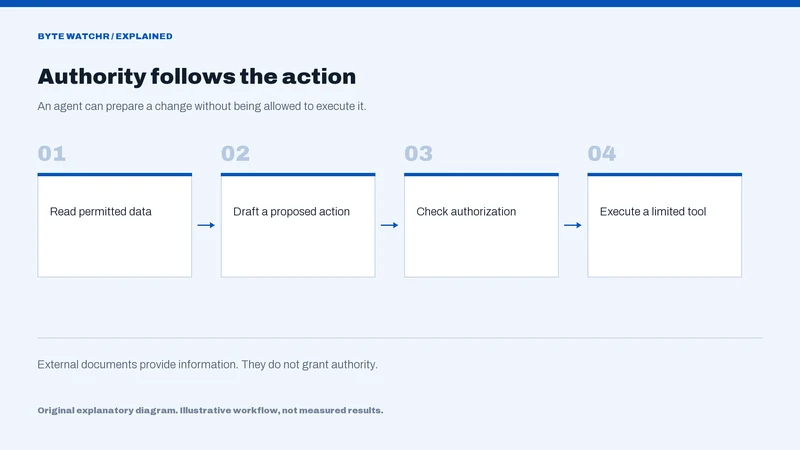
AWS introduced Strands Box on October 7 as an Apache 2.0 open-source developer preview for agent sandboxes. It combines operating-system containment with Dogwood policies that can consider previous actions and accumulated limits. Enforcement points include network egress, Shell and Python interpreters, and an MCP broker, using shared event history across those surfaces.
That history supports policies such as restricting outbound requests after an agent accesses customer data. Box is designed to work across agent harnesses. AWS also identifies a coverage gap: direct filesystem paths allowed through box.toml are contained, but their access does not appear in policy history. That limitation affects what a history-dependent rule can reliably observe.
Source: AWS: Introducing Strands Box
Why sequences matter
Many risky workflows are composed of individually ordinary actions. Reading a report and contacting an external endpoint may each be permitted in isolation. Together they can become a data transfer that the organization never intended. A policy that evaluates only the current request can miss that relationship, especially when several tools perform different pieces of the same task.
History-aware enforcement therefore needs a clear vocabulary for events. A rule must know what counts as accessing sensitive data, how long that state persists and whether it applies to one subprocess or the whole session. Teams should test those definitions against realistic tool behavior. If a broker records a request but an interpreter performs the actual read, the event model must still represent the relevant exposure.
The direct-filesystem limitation makes this concrete. Granting a path may be necessary for useful work, but a policy cannot react to an event that is absent from its history. Developers should inventory such paths and avoid claiming that every data access triggers subsequent restrictions. Containment and policy visibility are related controls with different evidence requirements.
Testing beyond a successful demo
A useful evaluation should include attempts to split a prohibited operation across tools. Try reading data through one interface and sending it through another, restarting a subprocess, exhausting a limit and retrying through a different interpreter. The objective is to confirm enforcement continuity rather than merely show that an allowed task can finish.
Configuration also belongs in version control. Changes to mounts, egress destinations and broker permissions can expand an agent’s effective authority without changing its prompt. Review those changes as operational permissions. Logs should record the active configuration and enough event history to explain a denial or an unexpected success.
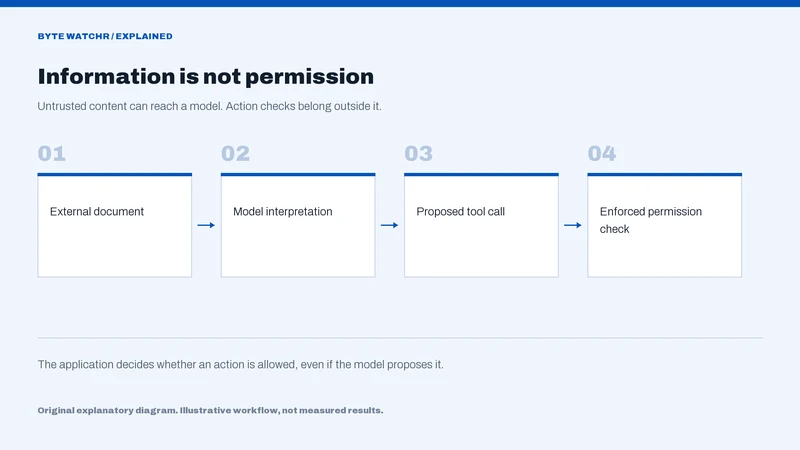
Byte Watchr’s assessment is that Strands Box offers a useful direction for agent control: decisions based on the workflow’s sequence, enforced outside the model. Its preview status and documented gaps call for bounded trials. Teams can test whether the event model covers their tools before making the sandbox a dependency for sensitive production work.
Sources & further reading
Factual statements are grounded in the linked material. Interpretation and illustrative examples are Byte Watchr analysis. Vendor claims are identified as claims, rather than independent testing.
The event date records the source announcement or documented operation. The coverage edition groups recent developments and is separate from the publication date. Actual publication is recorded above.
Corrections policy · About this byline