What to know
- The model has 740 million parameters and an Apache 2.0 license.
- Supported inputs include text, code, images, audio and video.
- Local retrieval needs independent relevance and access-control tests.
One retrieval space for several media types
Google released EmbeddingGemma 2 on October 6, describing a 740-million-parameter model that maps text, code, images, audio and video into a shared embedding space. Based on Gemma 4 and distributed under Apache 2.0, it offers modular encoders that permit smaller text-only deployments. The model supports an 8,000-token context and vectors that can be shortened from 768 dimensions.
Google positions the release for offline semantic search, code indexing and retrieval-augmented generation. Those are deployment possibilities rather than guarantees of relevance on a particular collection. Memory requirements vary with quantization and hardware, and the company’s comparative benchmark descriptions need testing against the files an organization actually searches.
Source: Google: EmbeddingGemma 2
Smaller vectors change the tradeoff
An embedding system converts material into representations that can be searched by similarity. Shorter vectors can reduce index size and transfer cost, but the relevant question is what information the smaller representation loses. Teams should compare retrieved results for their own queries, especially ambiguous requests and material that differs only in a small but important detail.
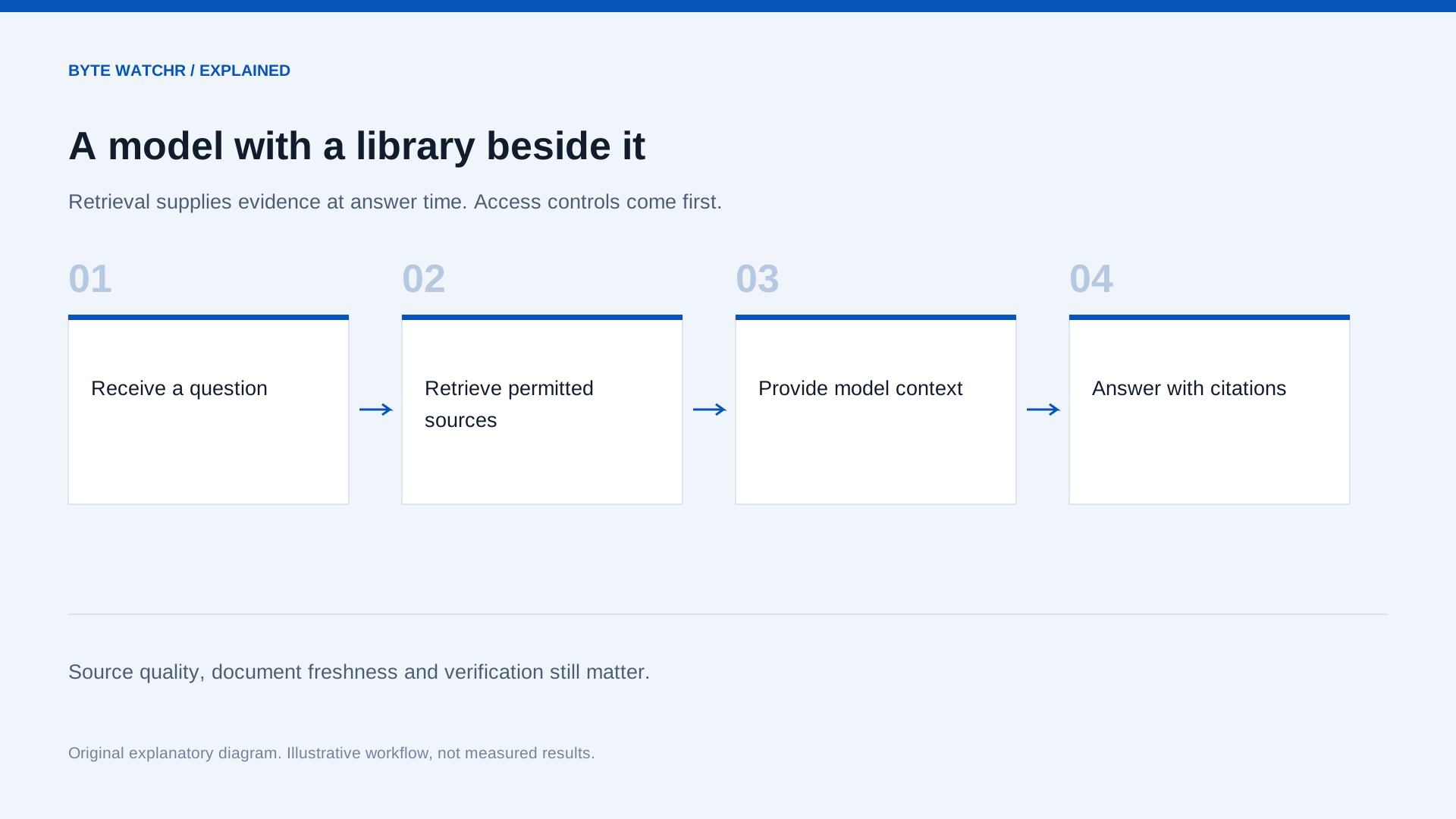
Multimodal retrieval adds another complication: the desired result may come from a different medium than the query. A spoken request might need a diagram, a code fragment or a video segment. Tests should measure whether the retrieved object genuinely supports the task, not simply whether it appears related. The right unit may be a passage or time range rather than an entire file.
Access control remains outside similarity. A local index can still expose private documents to the wrong local user if authorization is applied only during ingestion. Search should respect current permissions when results are returned. Revoked access, deleted files and stale vectors need explicit handling, otherwise an offline deployment can retain information longer than intended.
Build a retrieval evaluation before scaling
Start with queries written by people who know the collection and label useful answers. Include paraphrases, misspellings, negative examples and questions for which no supporting record exists. A system should be able to return no useful match rather than supplying a plausible but irrelevant item that later becomes a fabricated answer.
Measure resource use alongside quality. Index construction, encoder loading and repeated queries can have different memory peaks. Testing only a single query after the system is warm may understate the demands of an application that frequently starts and stops. Quantization choices should be recorded so that performance comparisons can be repeated.
Byte Watchr’s assessment is that EmbeddingGemma 2 gives developers more options for keeping retrieval near their data. The operational advantage follows only if relevance, permissions and resource use remain acceptable together. Open weights and a permissive license simplify experimentation, but the index still needs a maintenance process that keeps its content and authority aligned with the underlying files.
Sources & further reading
Factual statements are grounded in the linked material. Interpretation and illustrative examples are Byte Watchr analysis. Vendor claims are identified as claims, rather than independent testing.
The event date records the source announcement or documented operation. The coverage edition groups recent developments and is separate from the publication date. Actual publication is recorded above.
Corrections policy · About this byline