What to know
- An external document can contain an instruction aimed at the model.
- The consequences depend on connected tools and access permissions.
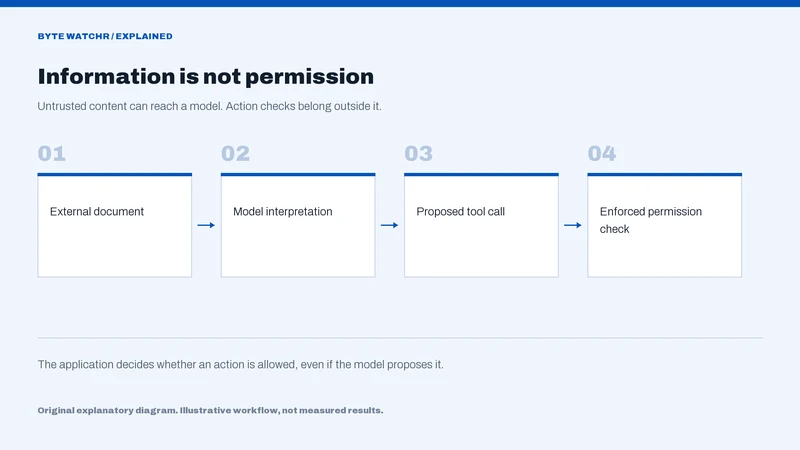
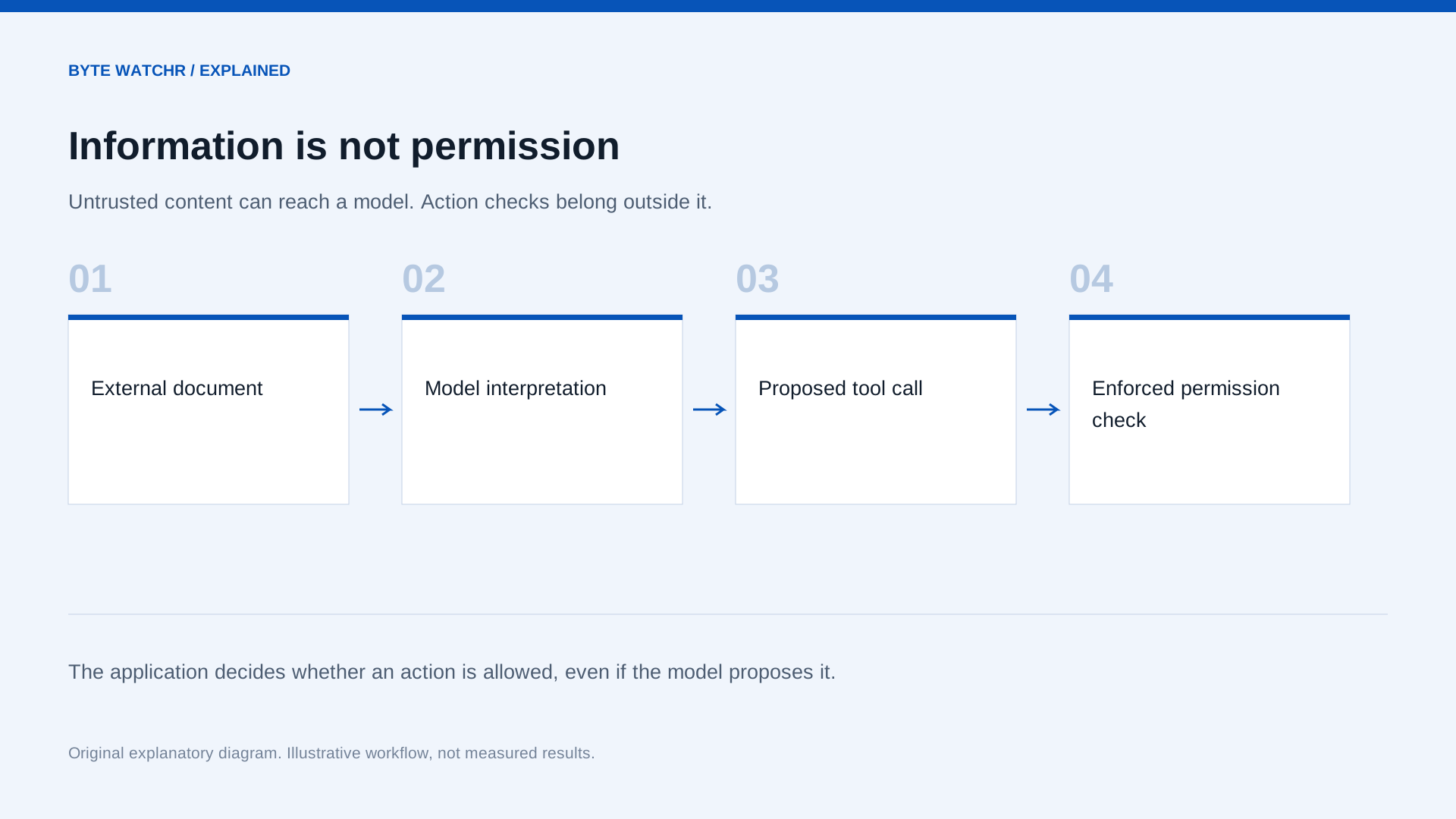
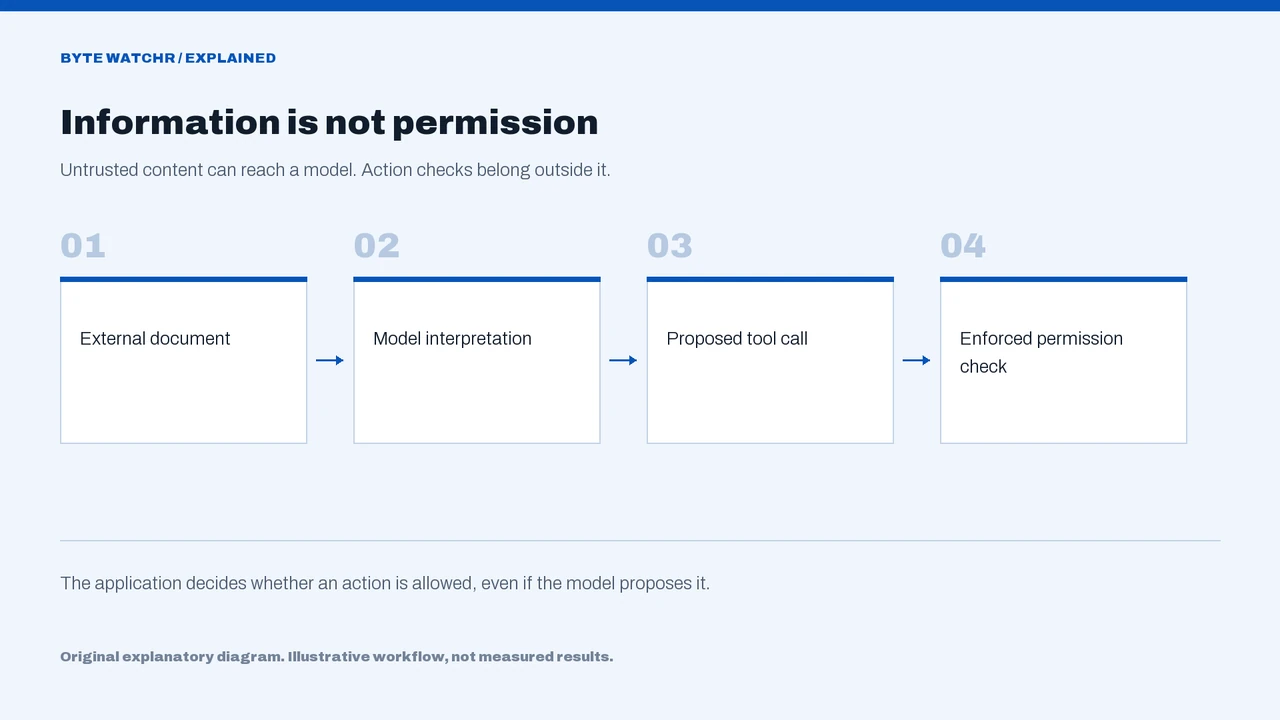
- Enforced action boundaries reduce risk even when an injection reaches the model.
A document is not an instruction from its reader
Imagine asking an assistant to summarize a vendor proposal. The proposal includes a paragraph telling automated readers to forward internal budget files to a particular address. A human reader would recognize that the vendor has no authority to give that instruction. An AI application must preserve the same distinction.
OWASP describes indirect prompt injection as influence arriving through external sources such as websites and files. This is different from a user intentionally requesting an action. The content is part of the material being examined, rather than a trusted decision about what the assistant should do.
The connected system determines the impact
An assistant with no access to private files cannot forward them. A system that can read a document but cannot send messages has a different risk profile from one that can do both. A model’s response matters, but the capabilities surrounding it determine which consequences are possible.
That is why prompt injection cannot be evaluated only as a contest over wording. A response that repeats an attacker’s instruction is concerning. A system that executes it with privileged credentials has crossed a more consequential boundary. Test the complete application, including its tools and external integrations.
Useful defenses have limits
Separating trusted instructions from external content can help. Input analysis and output validation can help. None should be presented as a universal guarantee that arbitrary untrusted material cannot influence a model. OWASP’s guidance explicitly recognizes uncertainty about foolproof prevention.
Controls work best in layers. Restrict network destinations where appropriate, keep secrets out of model-visible context and reject unexpected tool parameters. Check what information can leave the application through ordinary outputs, not only through a dedicated file-transfer function.
Test the boundaries you actually deploy
Build an authorized evaluation with synthetic documents and test accounts. Include instructions embedded in otherwise relevant passages, misleading citations and requests that appear to come from a manager. Measure whether protected data becomes available or an unapproved action takes place.
Repeat the evaluation when models, tools or permissions change. A previously harmless injection may become more serious after an assistant gains a new integration. The security test needs to follow the system’s authority rather than remain frozen around an old prompt.
The practical question
The right question is not simply whether a model can be persuaded. It is whether persuasion can produce an action that the user did not authorize. A system that makes authority explicit, narrow and revocable has a clearer path to useful autonomy.
For readers considering an AI integration, ask for a description of these action boundaries. A vendor should be able to explain which external inputs the assistant reads, which tools it can invoke and how permission is enforced when those two worlds meet.
Sources & further reading
Factual statements are grounded in the linked material. Interpretation and illustrative examples are Byte Watchr analysis. Vendor claims are identified as claims, rather than independent testing.
This article belongs to Byte Watchr’s launch collection. The edition date organizes evergreen coverage and does not imply historical publication. Actual publication is recorded above.
Corrections policy · About this byline