
What to know
- OpenAI models will support agents across Atlassian and Rovo.
- More than 3,000 Atlassian developers use Codex, the announcement says.
- Deeper Jira integrations are described as work the companies are exploring.
The agreement extends an existing relationship
Atlassian and OpenAI announced an expanded partnership on October 6, bringing models from the GPT-6 family into Atlassian’s platform and Rovo. The agreement builds on a collaboration that began in 2023. Rovo combines model capabilities with the Teamwork Graph, which connects organizational information about people, projects, documents and decisions.
OpenAI says more than 3,000 Atlassian developers already use Codex across terminals, development environments and code review. The announcement also describes Atlassian plugins that connect ChatGPT and Codex with work items and documentation, subject to permissions. Deeper Jira integrations for assigning work to agents and tracking results are still being explored. Those plans should be distinguished from integrations already available.
Analysis: Project context needs a reliable record
The practical value of connecting an agent to a project system depends on the quality of the project record. A launch assessment assembled from Jira tickets and Confluence documents can appear complete while missing a decision recorded elsewhere. Teams need to know which records were consulted, how recently they changed and whether an unresolved conflict remains between them.
Consider a milestone marked complete in an issue tracker while a design document still lists an unresolved dependency. An agent should preserve that discrepancy and identify the owners who can resolve it. Silently choosing one record would produce a cleaner summary at the cost of an important operational fact. Linking the assessment to its underlying evidence makes the result easier to review.
Permissions also need to survive the move between applications. A user’s ability to ask a question does not establish their right to retrieve every document that could answer it. The access decision should follow the identity and resource involved, including when an agent obtains context through a plugin. A project summary should not become a shortcut around the organization’s document controls.
Adoption and completed work require different measures
The developer adoption figure describes the reach of a tool inside Atlassian. It does not provide a controlled measure of delivery speed or software quality. Engineering leaders evaluating a similar deployment would need to count review effort, rejected changes, production defects and the maintenance required after generated code is merged.
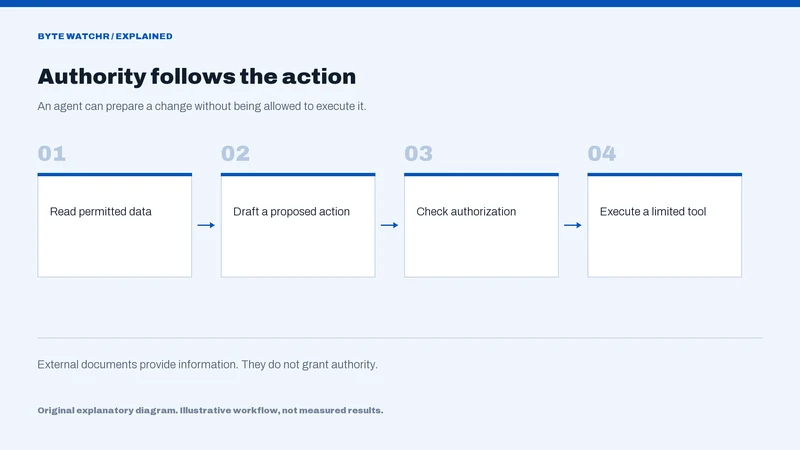
For agents that act on work items, the record should also show what changed and why. Assigning an issue, altering its acceptance criteria and closing it have different consequences. A workflow can allow an agent to prepare a proposed update while reserving consequential status changes for a responsible person. That makes responsibility visible without requiring every information lookup to become a separate approval task.
The agreement broadens access to models and organizational context. Its operational significance will depend on how customers connect those capabilities to their own rules and evidence. Specific rollout details and measured customer results will be more informative than assuming that a larger partnership immediately produces a uniform improvement across all teams.
Sources & further reading
Factual statements are grounded in the linked material. Interpretation and illustrative examples are Byte Watchr analysis. Vendor claims are identified as claims, rather than independent testing.
The event date records the source announcement or documented operation. The coverage edition groups recent developments and is separate from the publication date. Actual publication is recorded above.
Corrections policy · About this byline

_-1.jpg)