What to know
- Context capacity describes input size, not guaranteed recall.
- Relevant passages can be difficult to use inside a large, noisy input.
- Evaluate information selection and answer accuracy on the actual documents.
What a context window contains
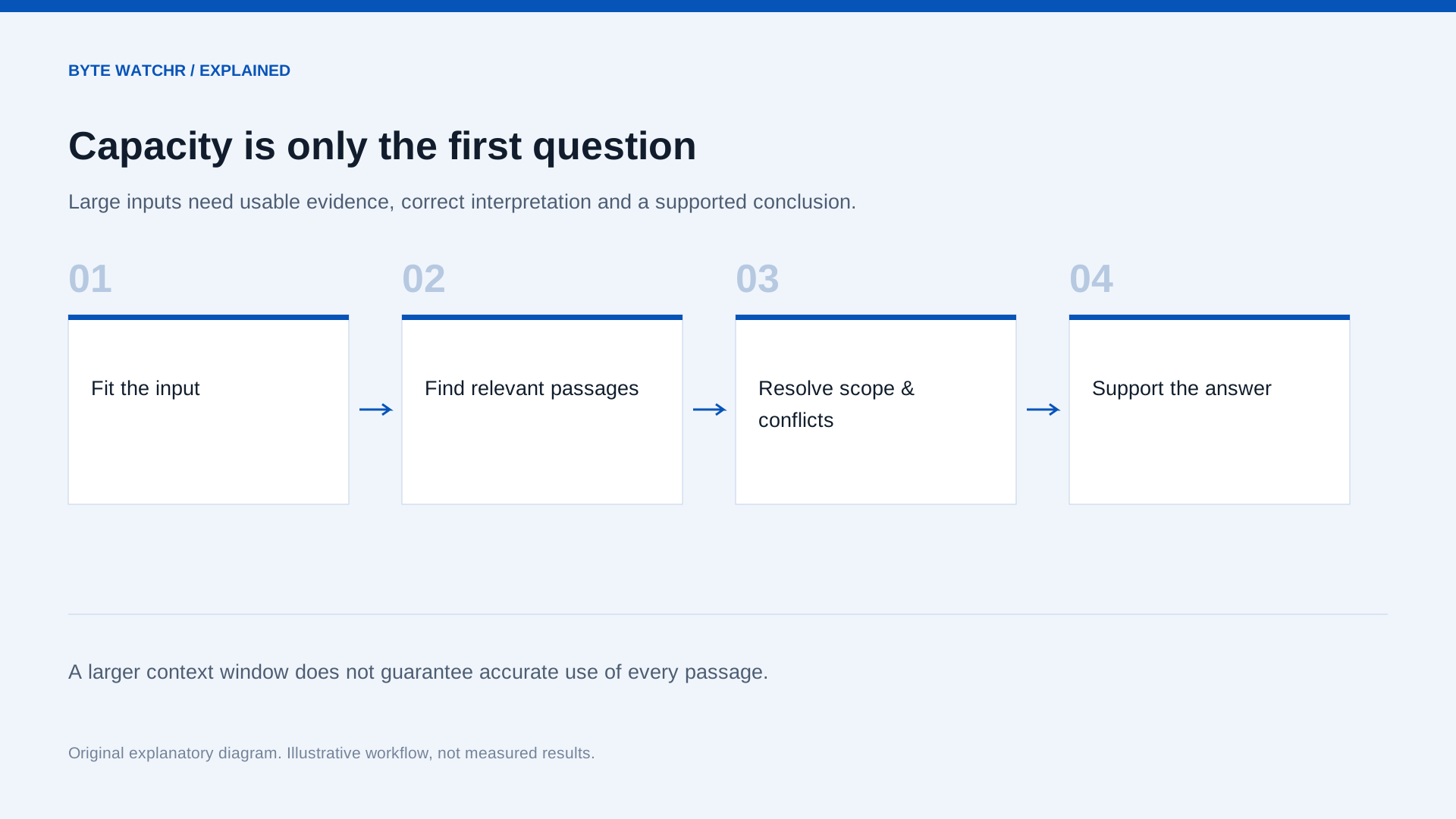
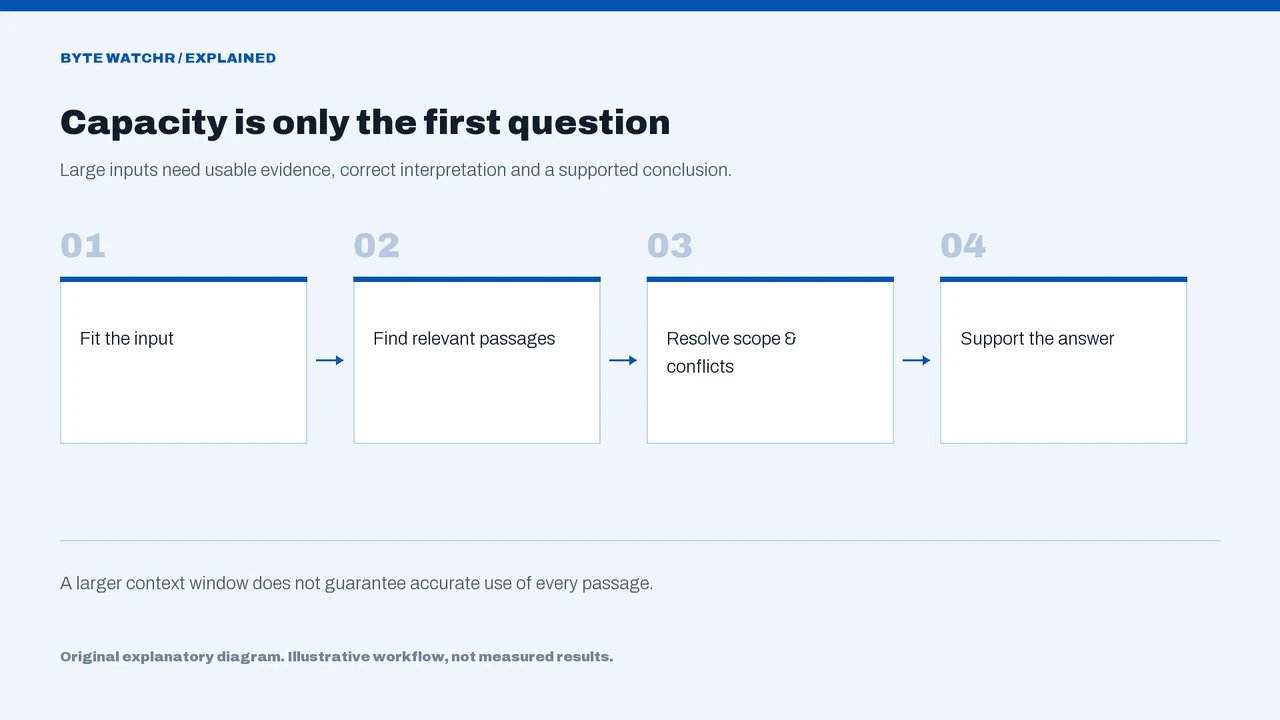
The context window is the material a model can consider during a particular interaction. It can contain a prompt, documents, prior messages and tool results. Increasing its size makes it possible to submit more material at once, but the limit is a capacity specification rather than a promise of perfect attention.
Think of the difference between receiving a large filing cabinet and finding the correct paragraph inside it. The cabinet may contain everything needed for a decision. A reliable process still has to identify the relevant file, notice exceptions and avoid being distracted by outdated instructions.
Position and noise matter
The research paper Lost in the Middle demonstrated that the models tested did not use information equally well at every position in a long input. Its results should not be treated as a permanent ranking of later models. They establish a reason to test retrieval behavior rather than infer it from advertised capacity.
A practical evaluation places the same fact at different locations, surrounds it with plausible distractors and changes the question’s wording. Test cases should also include two similar policies with different dates. Locating a keyword is easier than determining which policy actually governs the request.
Long context and retrieval are complementary
A large window can simplify a task when the entire relevant document set is modest. Retrieval can reduce the input when the collection is large or access depends on the user. Neither approach automatically solves source freshness, conflicting versions or permissions.
For a contract review, submitting the complete contract may preserve cross-references that passage-level retrieval would miss. For a company knowledge base, retrieving a small set of current, permitted documents may be more efficient. The correct design depends on how evidence is distributed.
Measure the cost of excess material
More input can increase processing time and expense. It can also make debugging harder: when an answer is wrong, a team must determine whether the model missed evidence, misunderstood it or selected an unrelated passage from thousands of alternatives.
Track answer quality alongside input size. If a shorter curated context achieves the same quality, the additional material may have no practical value. If the larger context helps, preserve examples showing exactly which relationships or exceptions required the extra space.
A useful acceptance test
Give the system questions whose answers require connecting multiple sections, plus questions that cannot be answered from the supplied material. Require references to specific supporting passages. Inspect whether those passages justify the conclusion and whether the system handles missing evidence honestly.
The goal is dependable use of information, not the largest possible prompt. A context window becomes valuable when the surrounding application helps the model find, compare and verify the evidence that matters.
Sources & further reading
Factual statements are grounded in the linked material. Interpretation and illustrative examples are Byte Watchr analysis. Vendor claims are identified as claims, rather than independent testing.
This article belongs to Byte Watchr’s launch collection. The edition date organizes evergreen coverage and does not imply historical publication. Actual publication is recorded above.
Corrections policy · About this byline