What to know
- NASA is testing AI across data discovery and operational support.
- A Mission Control assistant remains a prototype in the reported work.
- Scientific and operational answers need traceable evidence.
Several projects, different levels of maturity
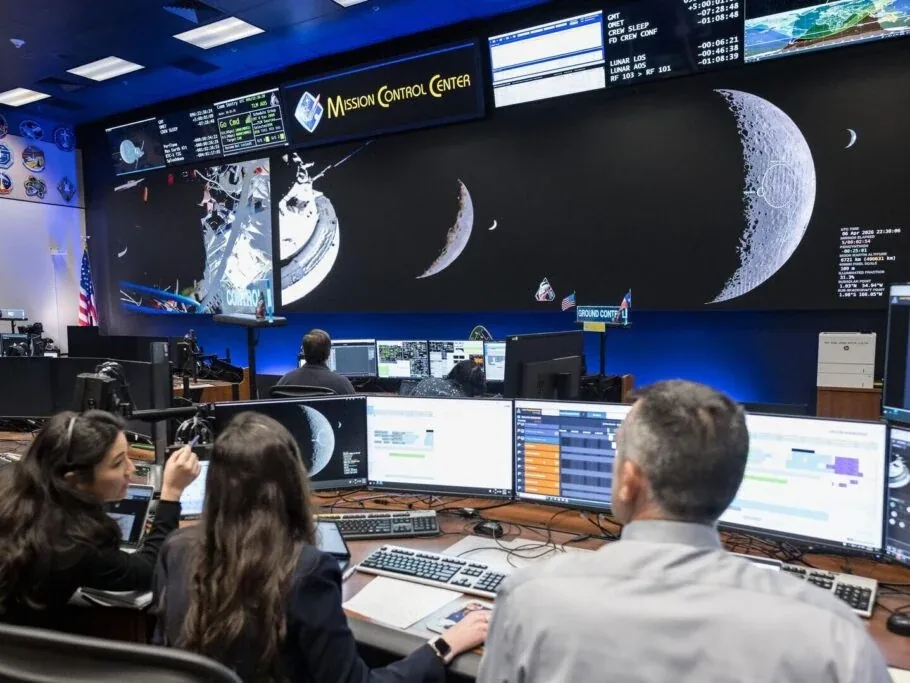
A September 28 Microsoft account describes NASA’s use of AI to connect scientific and operational information. Examples include Earth Copilot and Hydrology Copilot, developed with Microsoft, and a prototype assistant for flight controllers responsible for the International Space Station’s power and thermal systems.
The distinction between those projects matters. Natural-language access to a dataset, assistance in planning and participation in mission-support workflows involve different evidence and approval requirements. The reported prototype should not be read as an autonomous controller of spacecraft systems or as proof that a production deployment has replaced human responsibility.
Finding information is part of the scientific task
A conversational interface can make a complex archive easier to approach. The answer still depends on selecting the correct dataset, understanding its units and preserving the assumptions behind a calculation. A result can be fluent and numerically precise while drawing on observations that do not match the question’s location, period or resolution.
A useful scientific assistant should make those choices inspectable. The user needs to see which records were used, what transformations were performed and which limitations affect the conclusion. That allows another researcher to reproduce the work and identify whether disagreement comes from the source material, the calculation or the interpretation.
Missing information also needs a visible treatment. If an observation is unavailable for part of a requested period, filling the gap with an unstated assumption can create a misleading trend. A system that explicitly reports the gap may be more useful than one that always returns a complete-looking answer.
Operational support raises the acceptance standard
Byte Watchr’s analysis is that mission-support prototypes are best assessed as part of an existing decision process. A proposed assistant should demonstrate whether it helps specialists retrieve relevant evidence accurately and on time, including when information conflicts or a source is unavailable. The test is the quality of the supported decision, not merely the speed of generating a response.
Simulation offers a way to examine those conditions before operational use. Teams can introduce stale documents, ambiguous requests and interrupted tool calls, then observe whether the system identifies uncertainty and routes the issue appropriately. They can also check that the assistant’s output remains distinguishable from an authoritative instruction or a confirmed measurement.
The reported projects show how AI is being applied to the difficult work of connecting large information collections. Their significance lies in making that information more usable while retaining scientific and operational accountability. Evidence of traceability, reproducibility and performance under realistic constraints will determine how far each project can move beyond an initial demonstration.
Sources & further reading
Factual statements are grounded in the linked material. Interpretation and illustrative examples are Byte Watchr analysis. Vendor claims are identified as claims, rather than independent testing.
The event date records the source announcement or documented operation. The coverage edition groups recent developments and is separate from the publication date. Actual publication is recorded above.
Corrections policy · About this byline