What to know
- Poisoning changes the material used to shape or inform a model.
- A retrieval index and a training dataset have different failure modes.
- Keep provenance, approval history and a reversible version of important data.
Three points where data can change behavior
An AI system may consume data while a model is trained, during later adaptation or while retrieving information for a particular answer. Manipulating any of these inputs can influence the system, but the timing and control required are different. A team needs to identify which stage is actually exposed.
NIST’s adversarial machine learning taxonomy distinguishes attack types and the capabilities available to an adversary. That vocabulary is valuable because a broad warning about poisoned AI can obscure whether the attacker controls a public document, a training sample or the actual model artifact.
A practical retrieval example
Consider a company assistant that answers questions from an internal knowledge base. Someone changes a policy page to include an unauthorized payment exception. If the page enters the index without review, the assistant may repeat the exception even though the model itself has not been altered.
The defensive issue is partly ordinary content governance. Who can edit the source? Which changes require approval? How quickly can a document be withdrawn from retrieval? A trusted-looking answer cannot be more trustworthy than the material supplied to produce it.
Training changes are harder to unwind
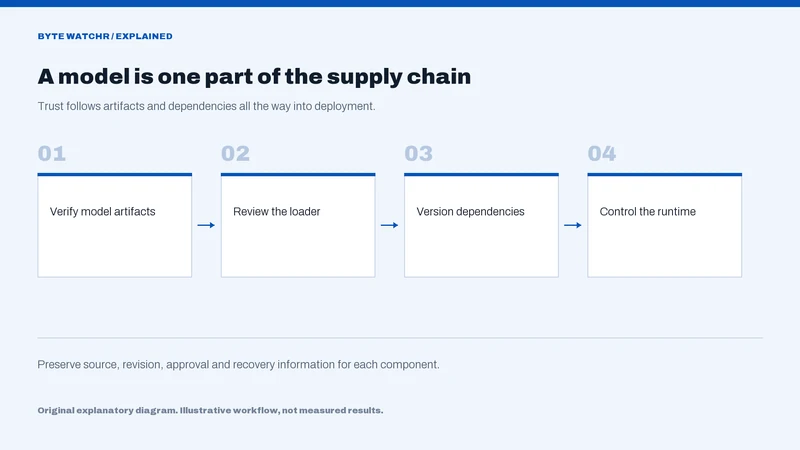
When bad information enters a training or adaptation process, deleting the original file may not remove its influence from the resulting model. The organization needs a record connecting datasets, processing steps and model versions, with a clean point from which the work can be repeated.
Versioning should preserve what was approved, not simply the latest file. Record licenses, data owners, checks and transformations. If a dataset is assembled from several sources, retain enough detail to identify which portion introduced an issue without rebuilding the entire collection blindly.
Validation must look beyond formatting
A data pipeline can validate that a field is a string or that an image opens successfully while missing a harmful change in meaning. Semantic review, sampling and targeted evaluation are necessary when the data influences important decisions.
For a classifier, look for changes in performance on particular groups or unusual triggers. For a retrieval system, test whether newly added sources override authoritative material incorrectly. The appropriate check depends on how the application uses the data, so one generic sanitization step is unlikely to be enough.
Keep a path to containment
Define which version can be restored if suspicious behavior appears. The rollback plan should cover the model, retrieval index and supporting application configuration. Otherwise an organization may replace a model while continuing to serve the compromised documents that caused the problem.
Preserve evidence before removing material, with access limited to the people investigating. Investigators need to distinguish intentional manipulation from stale content, labeling mistakes or ordinary drift. A strange answer is a signal to examine the pipeline, not proof by itself that poisoning occurred.
A useful operating standard
Every consequential AI data update should have an identifiable source, an accountable approval and a way to compare behavior before and after the change. This does not make poisoning impossible. It makes changes visible enough to investigate and reverse.
The security value comes from treating data as part of the system’s executable behavior. A model may be the most visible component, but the documents, labels and retrieval rules around it can determine what the application ultimately does.
Sources & further reading
Factual statements are grounded in the linked material. Interpretation and illustrative examples are Byte Watchr analysis. Vendor claims are identified as claims, rather than independent testing.
This article belongs to Byte Watchr’s launch collection. The edition date organizes evergreen coverage and does not imply historical publication. Actual publication is recorded above.
Corrections policy · About this byline