What to know
- Model artifacts need provenance and controlled loading.
- Dependencies and connected tools expand the AI supply chain.
- An inventory is useful only when it reaches the deployed version.
Follow the artifact into production
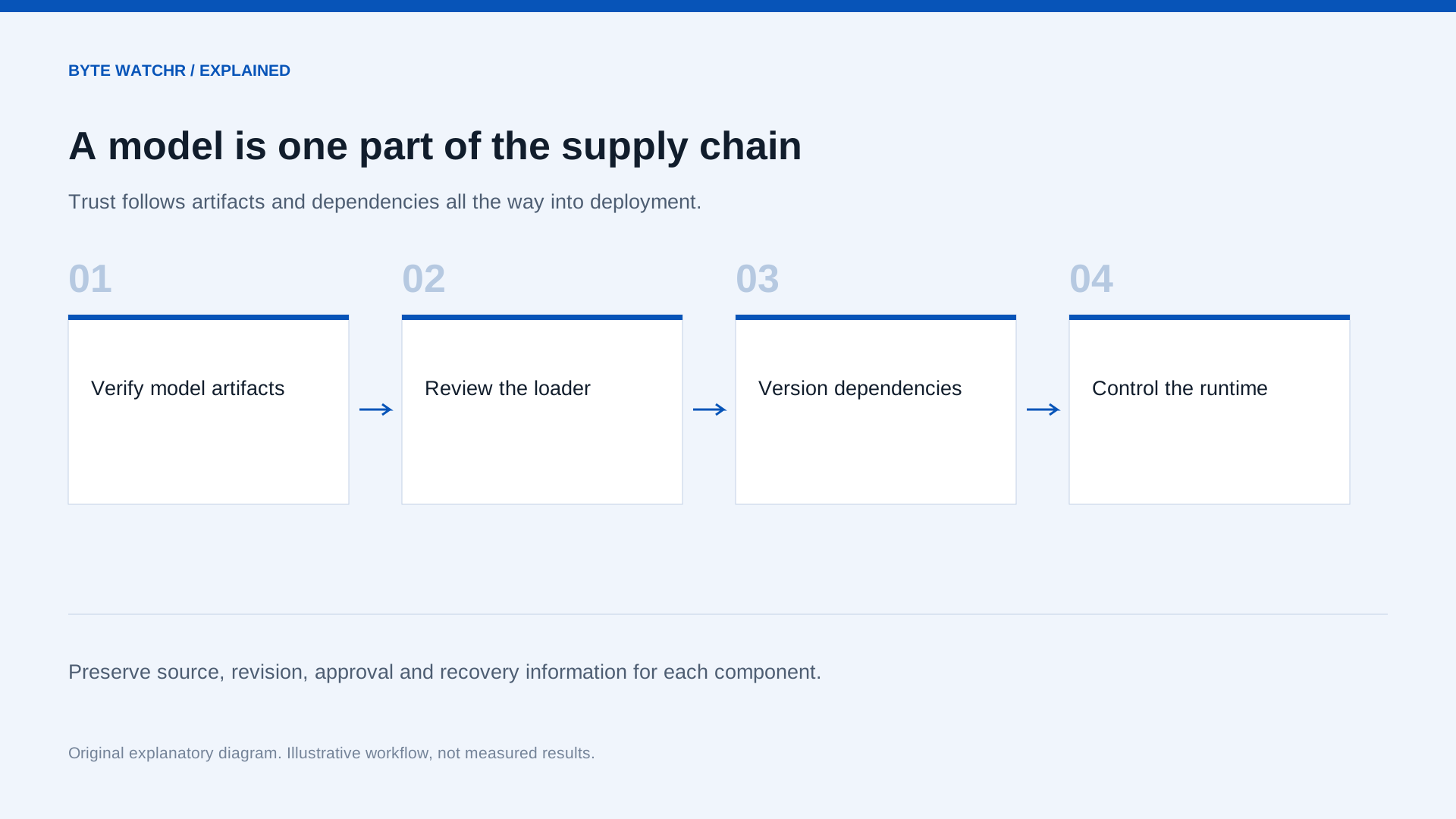
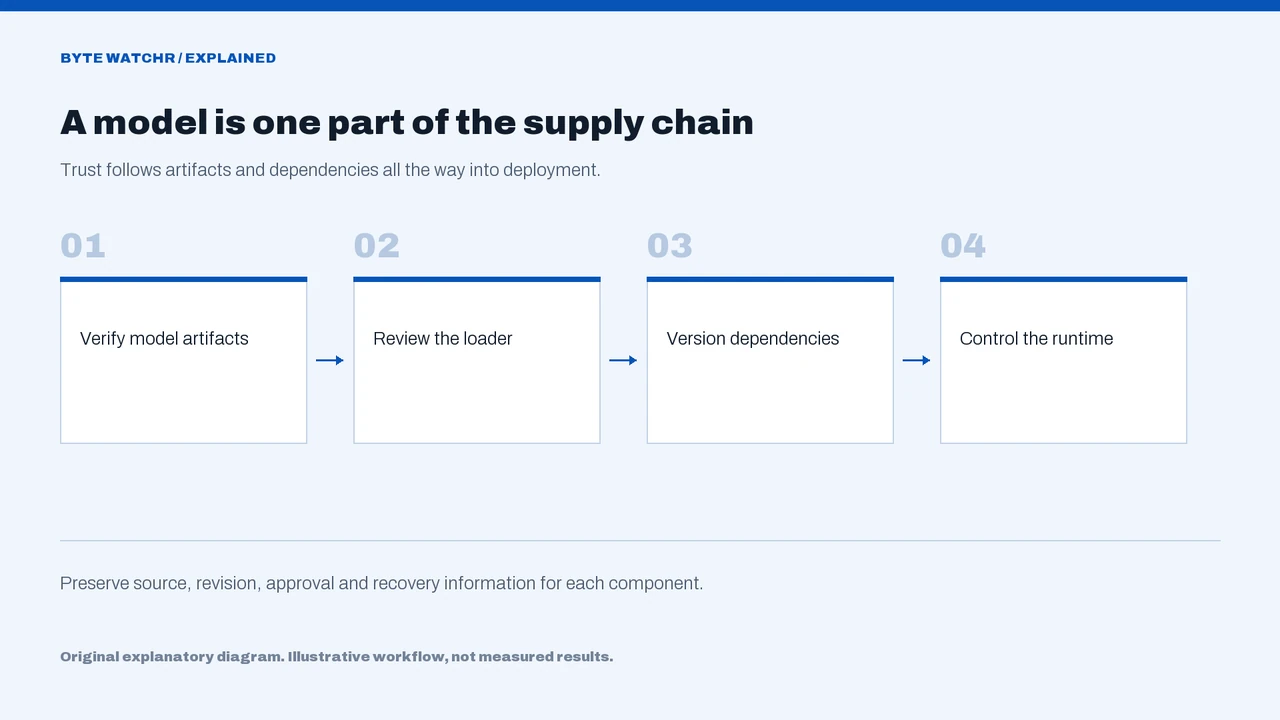
A downloaded model is rarely the whole application. It may require a tokenizer, configuration files, specialized libraries, numerical kernels and a serving framework. The application may then add retrieval, tools and external connectors. Every layer introduces another source of code or data that influences behavior.
OWASP’s AI supply-chain guidance and the NCSC’s secure development recommendations both make this broader boundary visible. The practical lesson is to review the system that will actually run, rather than approve a model name and assume the rest follows automatically.
Understand the loader
Some file formats and repository loading mechanisms can execute code. A team should know whether loading an artifact treats it as data or invokes additional scripts. A familiar model name does not establish that a particular copy or associated repository is trustworthy.
Prefer documented formats and restrict optional remote-code loading unless it has been reviewed. Record the source repository, exact revision and integrity information for approved artifacts. Use a controlled environment to inspect a new dependency rather than evaluating it with broad access to production secrets.
Separate distribution from endorsement
A marketplace or model hub helps people find artifacts. Presence on that platform does not necessarily mean every component received an independent security review. Popularity, download counts and a professional description should not replace an examination of provenance and behavior.
For an enterprise deployment, assign someone to own each approval decision. If an artifact is copied into an internal store, retain its license and original source information. The internal copy should remain traceable rather than becoming an unlabelled file that later teams treat as authoritative.
Tools can widen trust silently
An assistant that gains a connector to a document service or issue tracker now depends on that connector’s code, authentication and permissions. A tool update can change what the agent may do even when the model and prompt remain unchanged.
Review connectors as application integrations. Check scopes, data handling, destinations and the way errors are reported. Remove unused tools from the deployed configuration. A capability that exists only for an old experiment can remain a source of risk if the agent can still invoke it.
Inventory the deployment, not the plan
An inventory should connect the model and its dependencies to the environment running them. It needs enough specificity to answer whether a newly disclosed issue affects the actual installation. A list of product names cannot distinguish a safe revision from a vulnerable one.
Keep build and release records linked to the inventory. When a team substitutes a library or changes an execution backend, rerun relevant checks. Performance tuning often changes the technical supply chain and deserves the same traceability as a feature release.
Prepare for replacement
Maintain a tested alternative or rollback procedure for critical components. Know how to revoke connector credentials and pause tool execution without taking every unrelated service offline. This limits the disruption when a component has to be withdrawn quickly.
AI supply-chain security is a form of operational clarity. The organization should know what it runs, why it trusts each part and which action it can take when that trust changes.
Sources & further reading
Factual statements are grounded in the linked material. Interpretation and illustrative examples are Byte Watchr analysis. Vendor claims are identified as claims, rather than independent testing.
This article belongs to Byte Watchr’s launch collection. The edition date organizes evergreen coverage and does not imply historical publication. Actual publication is recorded above.
Corrections policy · About this byline